-
High Court


Wife pursues 498A case despite taking 20 Lakhs Alimony from Husband for Divorce after Compromise: Rajasthan HC quashes case. Criticises growing trend where wives pursue criminal cases despite settlement.

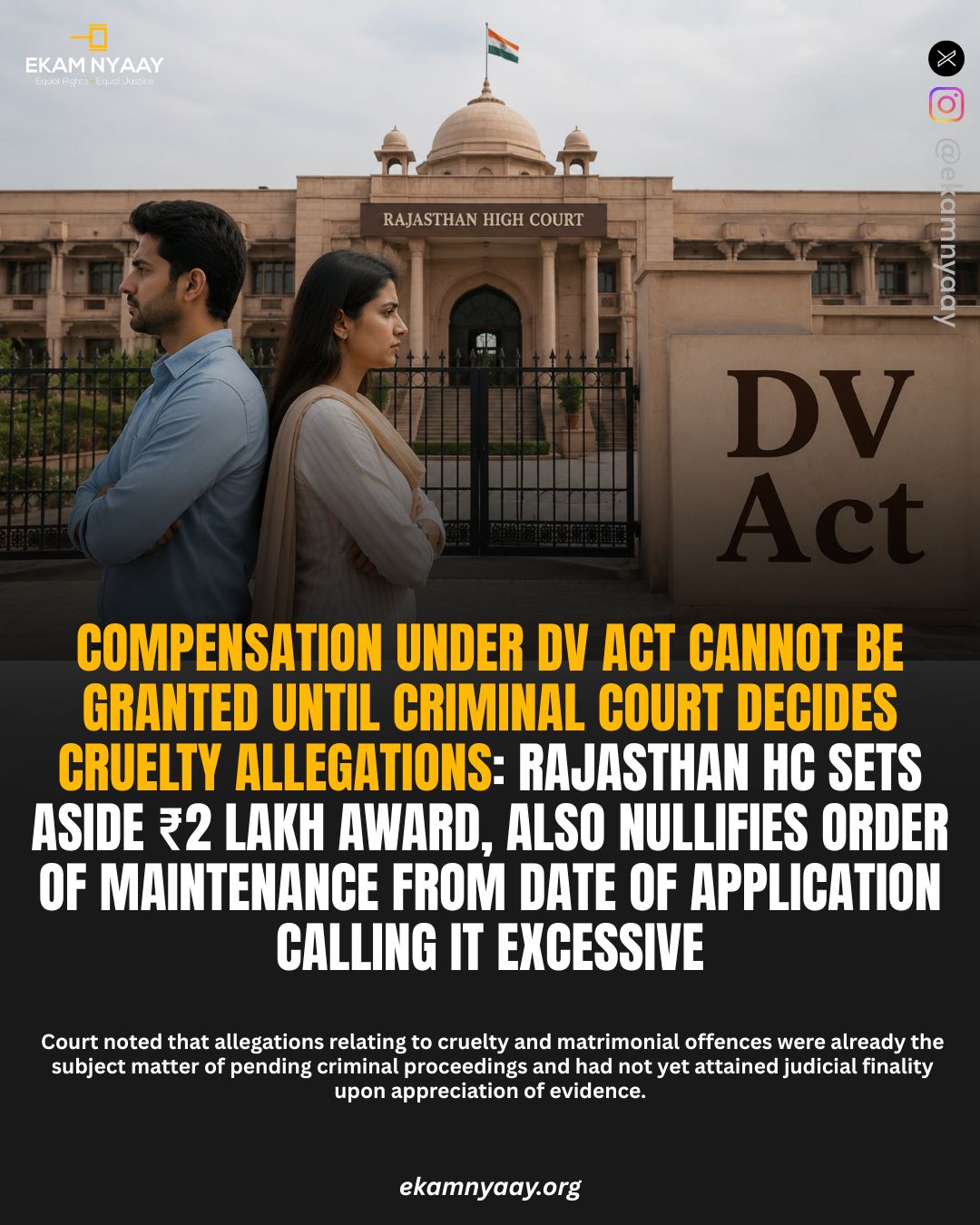
In Satyapal Sharma & Anr. v. State of Rajasthan & Anr., Rajasthan HC held that the continuation of criminal proceedings by a wife against her former husband and in-laws, after accepting ₹20 lakh as permanent alimony and obtaining a decree of divorce on the basis of a compromise, amounted to an abuse of the process of law.
Court stated, “The respondent-wife having received the decree of divorce from the husband without contest on the basis of the terms of the compromise, cannot now be allowed to go back upon her proclaimed stand and take a somersault.”
The case arose from an FIR registered u/s 498A and 406 IPC and 4 of Dowry Prohibition Act, wherein the wife alleged dowry harassment and cruelty against her husband and his family members.
During the pendency of trial, husband filed a petition for divorce u/s 13 HMA. Family Court granted a decree of divorce on 18 Oct 2019. The wife challenged the decree before Rajasthan HC and during the proceedings, parties entered into a compromise whereby wife agreed to accept a lump-sum amount of ₹20 lakh as permanent alimony. Pursuant to settlement, amount was paid through a demand draft, wife’s appeal was dismissed, and a decree of divorce was granted on 17 February 2025.
The petitioners contended that despite accepting ₹20 lakh as permanent alimony and securing a mutually agreed divorce, wife did not withdraw the criminal case. They further argued that although charges had been framed in 2018, neither the complainant nor any of the witnesses had been examined.
Upon examining the record, High Court noted that there was no dispute that the marriage had been dissolved, the wife had accepted ₹20 lakh as permanent alimony, and yet the criminal trial had made no progress because the complainant had repeatedly failed to appear for recording of evidence.
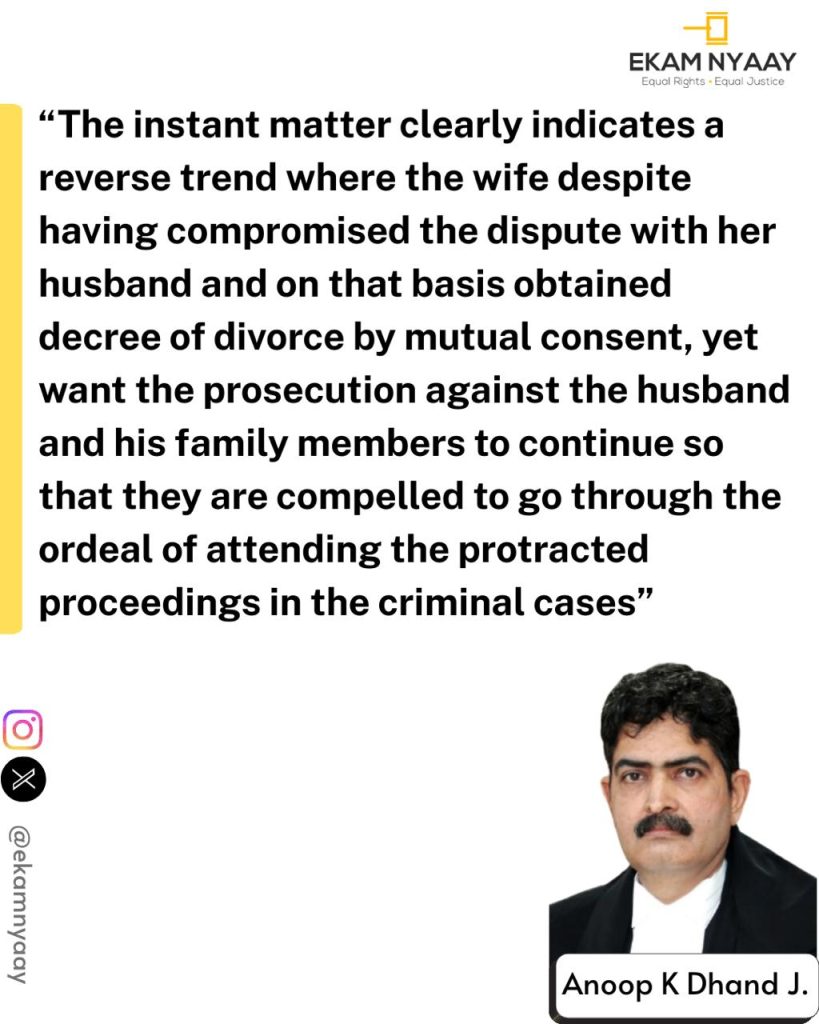
Court further remarked that the present case reflected a “reverse trend” where, despite obtaining a divorce and monetary settlement, the wife sought to continue the criminal prosecution against her husband and his family members.
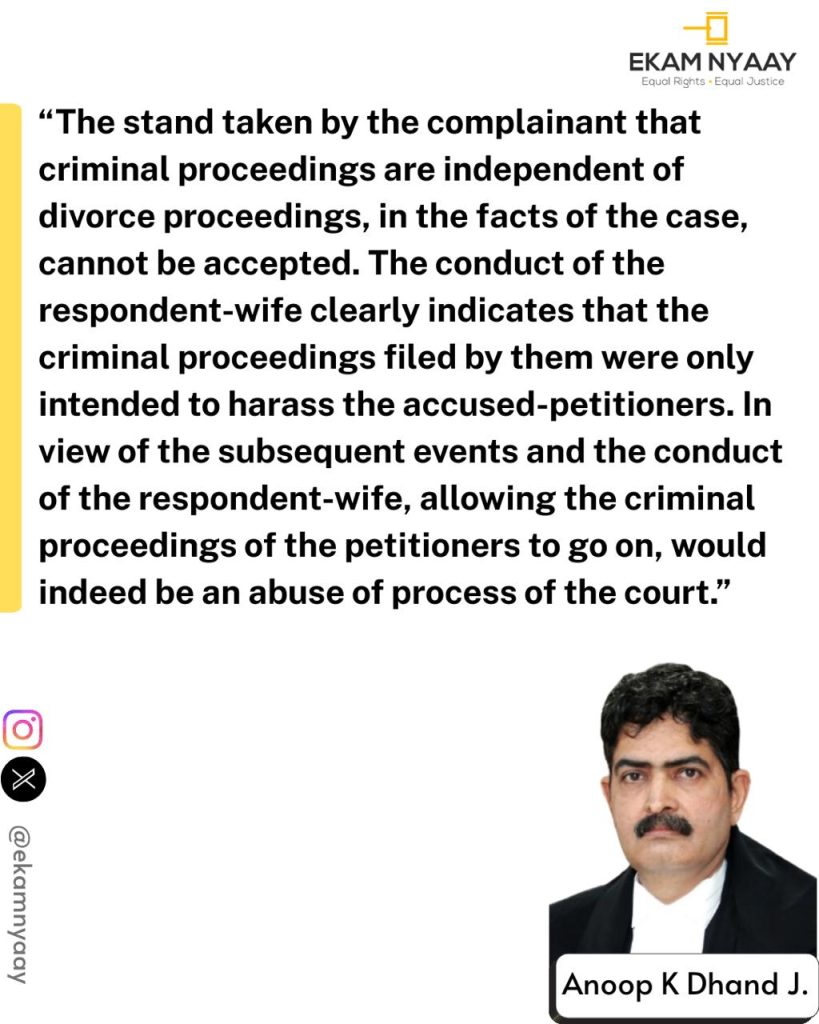
Rejecting the wife’s contention that criminal proceedings are independent of divorce proceedings, Court held that such an argument could not be accepted in the peculiar facts and circumstances of the case. It observed that judicial proceedings cannot be permitted to become instruments of harassment once the matrimonial dispute has been fully settled and the parties have acted upon the settlement.
Accordingly, Rajasthan High Court allowed the petition and quashed the entire criminal proceedings pending against the petitioners.