-
High Court


Breakdown Of Consensual Premarital Relationship Resulting In Criminal Case Not A Reflection Of Poor Moral Character: Supreme Court Sets Aside Order Cancelling Appointment Of A Police Constable
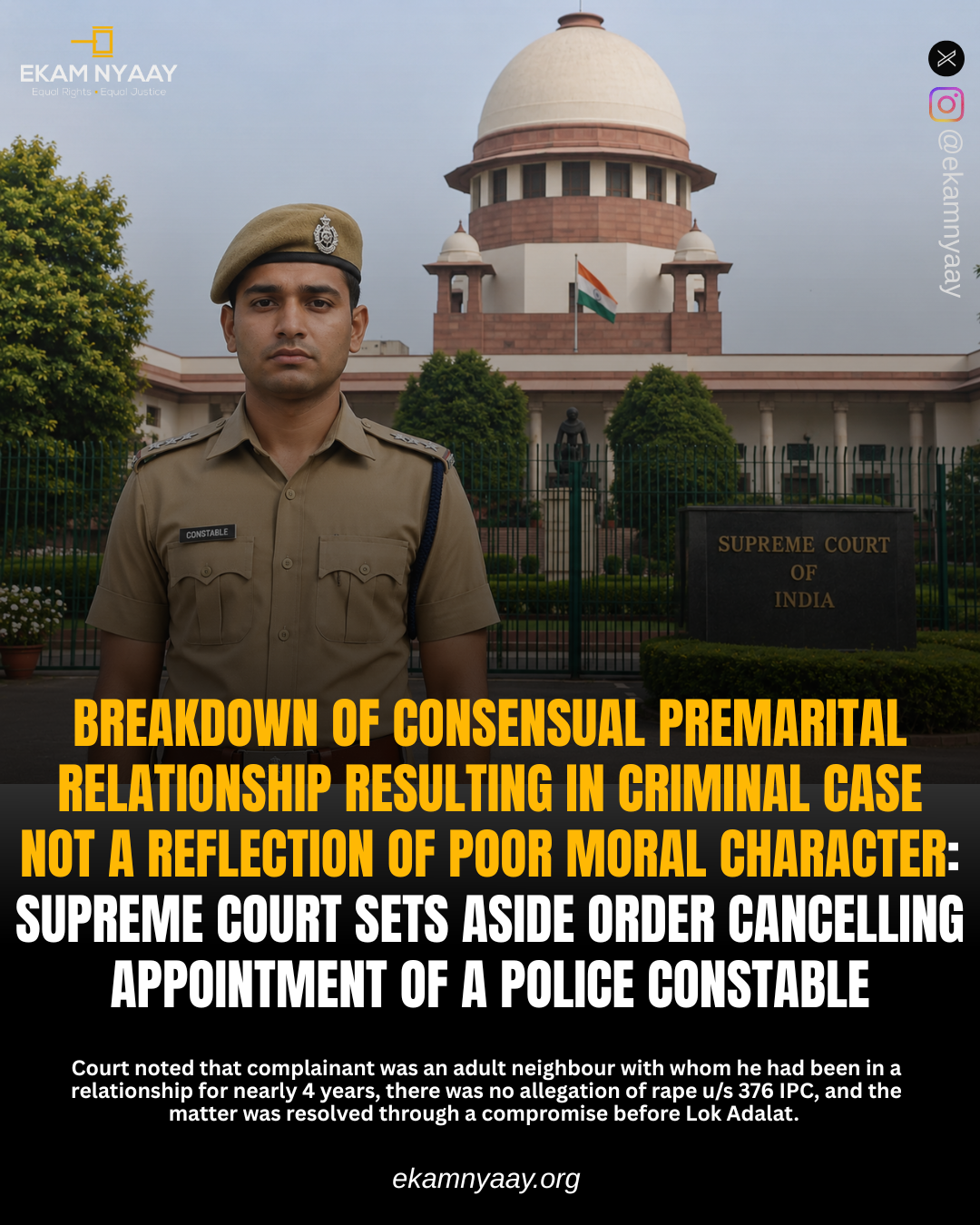
In Gajula Thirupathi v. Telangana State Level Police Recruitment Board & Ors., SC held that a consensual premarital relationship between two unmarried adults cannot be treated as a reflection of poor moral character.
Court allowed the appeal of Gajula Thirupathi, whose selection as a Police Constable in Telangana had been cancelled due to his involvement in a criminal case arising from a failed romantic relationship.
The appellant had been provisionally selected for the post of Police Constable. During verification, authorities found that he had previously been named in a case u/s 417, 420, and 506 IPC. The complainant, his neighbour, alleged that he had maintained a romantic relationship with her for several years on a promise of marriage but subsequently married another woman. However, case was compounded before a Lok Adalat in 2015.
The appellant had truthfully disclosed the criminal case in his attestation form. Despite this disclosure, Recruitment Board cancelled his candidature, treating allegations as involving moral turpitude and concluding that he was unsuitable for appointment to police force. The Board further reasoned that compromise before Lok Adalat amounted to an admission of guilt and that an innocent person would not have settled the case.
Court noted that the complainant was an adult neighbour with whom the appellant had been in a relationship for nearly 4 years, there was no allegation of rape u/s 376 IPC, and the matter was resolved through a compromise before Lok Adalat. Court also emphasised that there was no material suggesting that the complainant had entered into the compromise because of threats, coercion, or inducement.
Therefore, Court strongly criticised Recruitment Board’s assumption that the compromise amounted to an admission of guilt. Court observed, “statement that the appellant compromised because he was guilty is completely perverse and defies logic.”
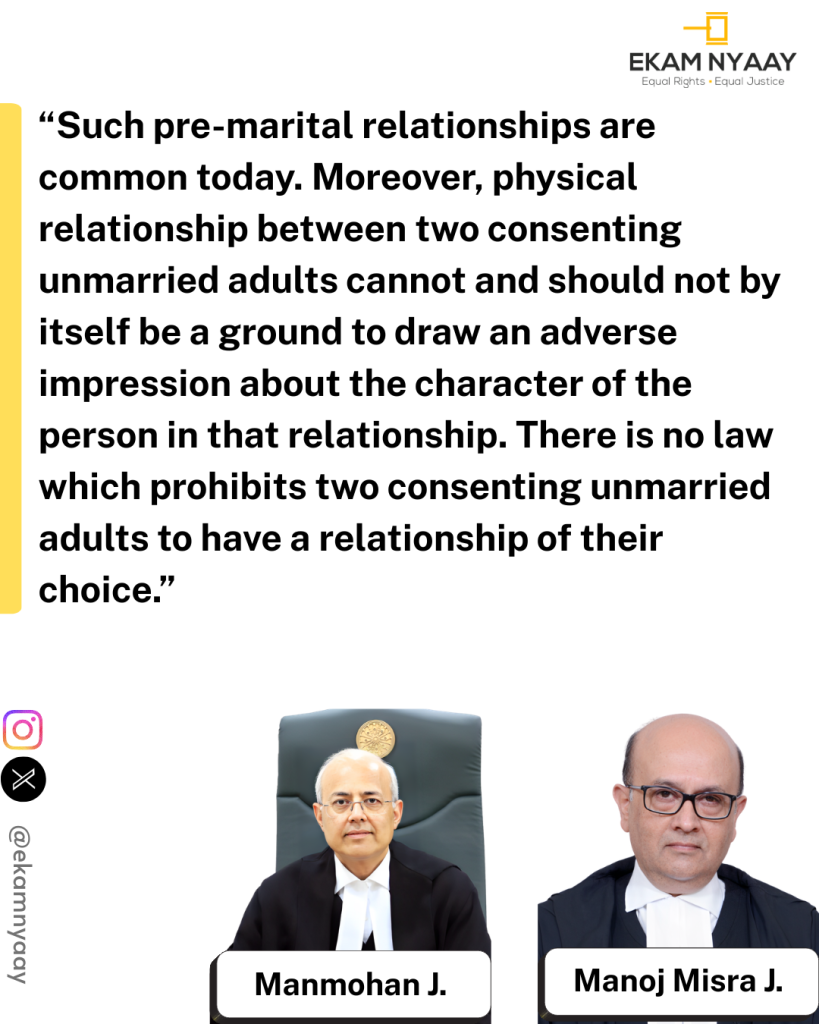
Court also took note of changing social realities and consensual relationships between adults. It held that authorities cannot automatically infer poor character merely because a premarital relationship does not culminate in marriage.
Addressing the allegation of cheating, Supreme Court observed that not every failed relationship amounts to deception. Since the complainant herself chose not to pursue the allegations and agreed to compound the offence, there was insufficient material to conclude that the appellant had deceived her.
Consequently, Supreme Court held that the decision of Screening Committee was arbitrary and restored the order directing reconsideration of the appellant’s appointment.