-
Supreme Court


Supreme Court Lays Down Safeguards To Prevent Misuse Of POCSO In Matrimonial And Child Custody Disputes, Quashes FIR Against Father After CBI Finds Allegations Unsustainable
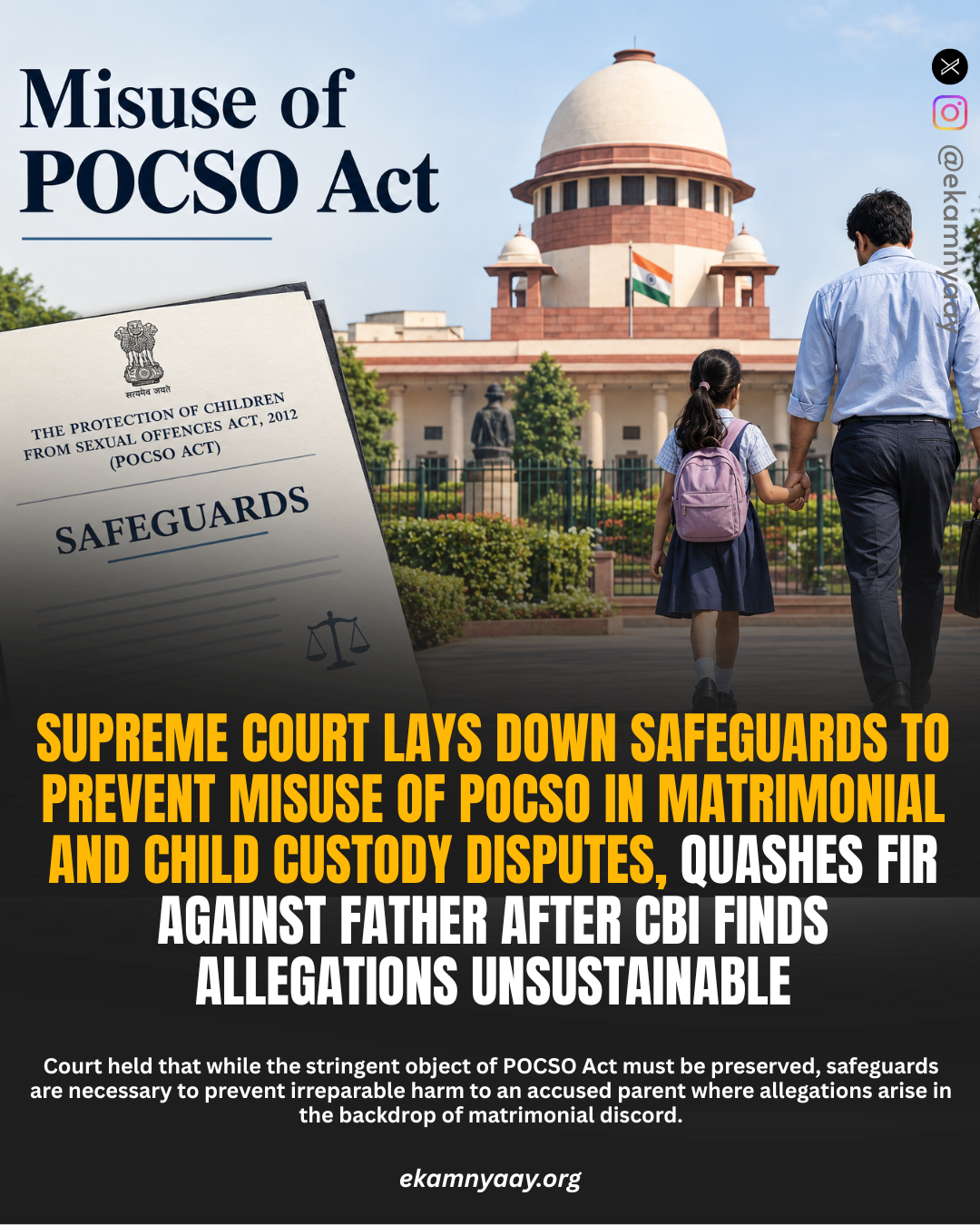
In this case, while quashing FIR alleging sexual offences under POCSO Act against a father, Supreme Court laid down safeguards to prevent the misuse of POCSO proceedings in matrimonial and child custody disputes.
Court held that while the stringent object of POCSO Act must be preserved, safeguards are necessary to prevent irreparable harm to an accused parent where allegations arise in the backdrop of matrimonial discord. It observed that such allegations can have serious consequences not only for the accused but also for child and parent-child relationship.
The case arose from the matrimonial dispute between ‘R’ (father) and ‘E’ (mother), who married in 2011 (second marriage for both of them) and had a daughter ‘M’ in 2015. Serious differences arose between parties, and mother left matrimonial home with the child in April 2018.
The father subsequently instituted guardianship proceedings and other criminal proceedings against the mother. In March 2022, Family Court directed that custody of then 7-year-old child be handed over to the father. Karnataka High Court upheld the decision in January 2023 while granting visitation rights to the mother. Supreme Court subsequently dismissed mother’s challenge to custody order, and custody was handed over to the father on 7 June 2023.
After the child was in father’s custody, mother lodged FIR on 28 March 2024 alleging that father had sexually abused the minor child and members of his family had also subjected her to ill-treatment.
Considering the seriousness of allegations, SC directed CBI to investigate the matter through a committee headed by a DIG and including experts in psychology and child psychiatry. CBI committee examined several witnesses, including child’s teachers, school counsellor, housemaid and neighbours, analysed CCTV footage from father’s residence and considered the psychological and psychiatric evaluation of child.
CBI investigation found significant inconsistencies and absence of independent corroborative material supporting the allegations. The psychological and psychiatric assessment also found no signs of anxiety or trauma consistent with the allegations.
CBI ultimately concluded that allegations were not made out and that matter was not fit for prosecution. Therefore, Supreme Court, after examining the detailed investigation and material, accepted CBI’s conclusion and held that continuing the proceedings would amount to a “gross abuse of process”.
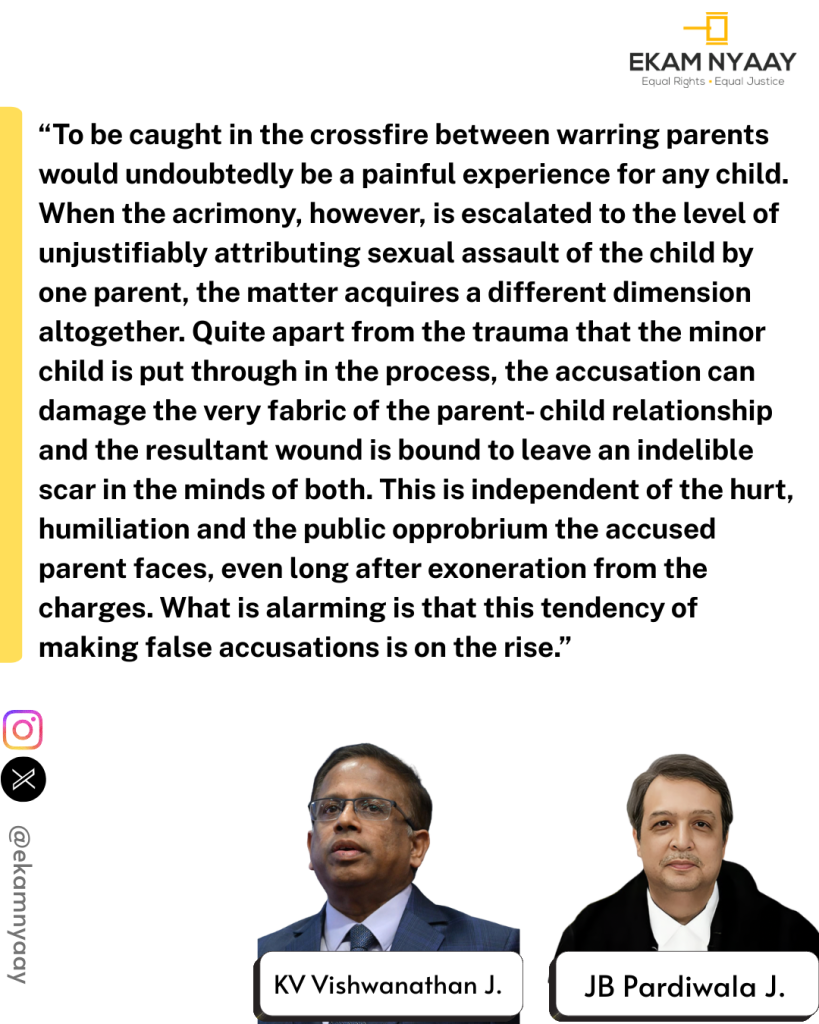
Court also considered the wider problem of POCSO allegations being raised during matrimonial and custody disputes. It noted that although Section 22 of POCSO Act provides punishment for knowingly making false complaints, the provision may operate only after considerable harm has already occurred, including loss of liberty and adverse consequences in parallel custody proceedings.
Court therefore held that preventive safeguards were necessary and restricts the safeguards to cases where two conditions coexist: first, the alleged POCSO offence is attributed to a parent or another family member living under the same roof as the child and second, there is a matrimonial dispute between the child’s parents indicating a strained relationship. The police officer receiving the complaint must verify the existence of such matrimonial dispute.
In relation to arrest, Court clarified that registration of a POCSO FIR does not automatically justify arrest. Under Section 35 BNSS, the power to arrest is discretionary and statutory conditions must be satisfied before it is exercised. Court reiterated that existence of the power to arrest and justification for exercising that power are distinct.
In cases satisfying the threshold conditions, IO should not act hastily or immediately resort to coercive action. Before deciding whether there is sufficient reason to believe that accused committed the offence for the purpose of arrest, IO is required to engage an expert in child and adolescent psychiatry or clinical psychology, ordinarily in consultation with the DCPU or DLSA.
Court also extended safeguards to private complaints filed directly before a Special Court under Section 33 POCSO Act. Where the same threshold conditions exist, Special Court must involve an expert in child and adolescent psychiatry or clinical psychology before deciding whether there are sufficient grounds to proceed and issue summons.
Court stressed that registration of POCSO case cannot, by itself, determine the outcome of parallel custody proceedings. Referring to principle recognised in Suhara v. Muhammed Jaleel, Court stated that mere registration of POCSO case should not automatically lead to an inference that allegation is true or be used to defeat a parent’s legitimate claim for custody. The concerned court must examine the relevant material and form a prima facie view, on the facts of each case, regarding whether the allegations are baseless.
Court further directed every District Child Protection Unit to update its expert register under Rule 5 POCSO Rules, 2020, to include experts in child and adolescent psychiatry and clinical psychology. Courts dealing with remand and bail in cases satisfying the threshold conditions were directed to examine whether IO had complied with the statutory requirements relating to arrest.
Court also directed that copies of judgment be circulated to Registrar Generals of all High Courts and Chief Secretaries of all States and Union Territories, with particular attention to the safeguards.
Also, applying the welfare-of-the-child principle, Supreme Court held that child’s welfare would be best served by custody and guardianship with the father. Court concluded that FIR had been registered for the purpose of laying a foundation for restoring custody to the mother and following the CBI's findings, the basis for that claim had been “shattered”.
Accordingly, Court quashed the FIR against the father and directed that legal custody of the child remain with him.
Since physical custody had remained with the mother since March 2024, Court did not order immediate physical transfer but remitted the matter to Family Court for a structured process of reintegration, to be assisted by a committee comprising 2 CBI officers and 2 NIMHANS experts involved in the investigation.
The committee was directed to determine interim custody arrangements pending reintegration, while Family Court was to subsequently determine appropriate visitation arrangements for the mother.