-
Supreme Court


Monetary Settlements In Rape & Molestation Cases Arising Out Of Consensual Relationships Undermining Sanctity Of Law: Supreme Court Of India Refuses Enforcement Of 9.25 Lacs Settlement Demanded By Woman
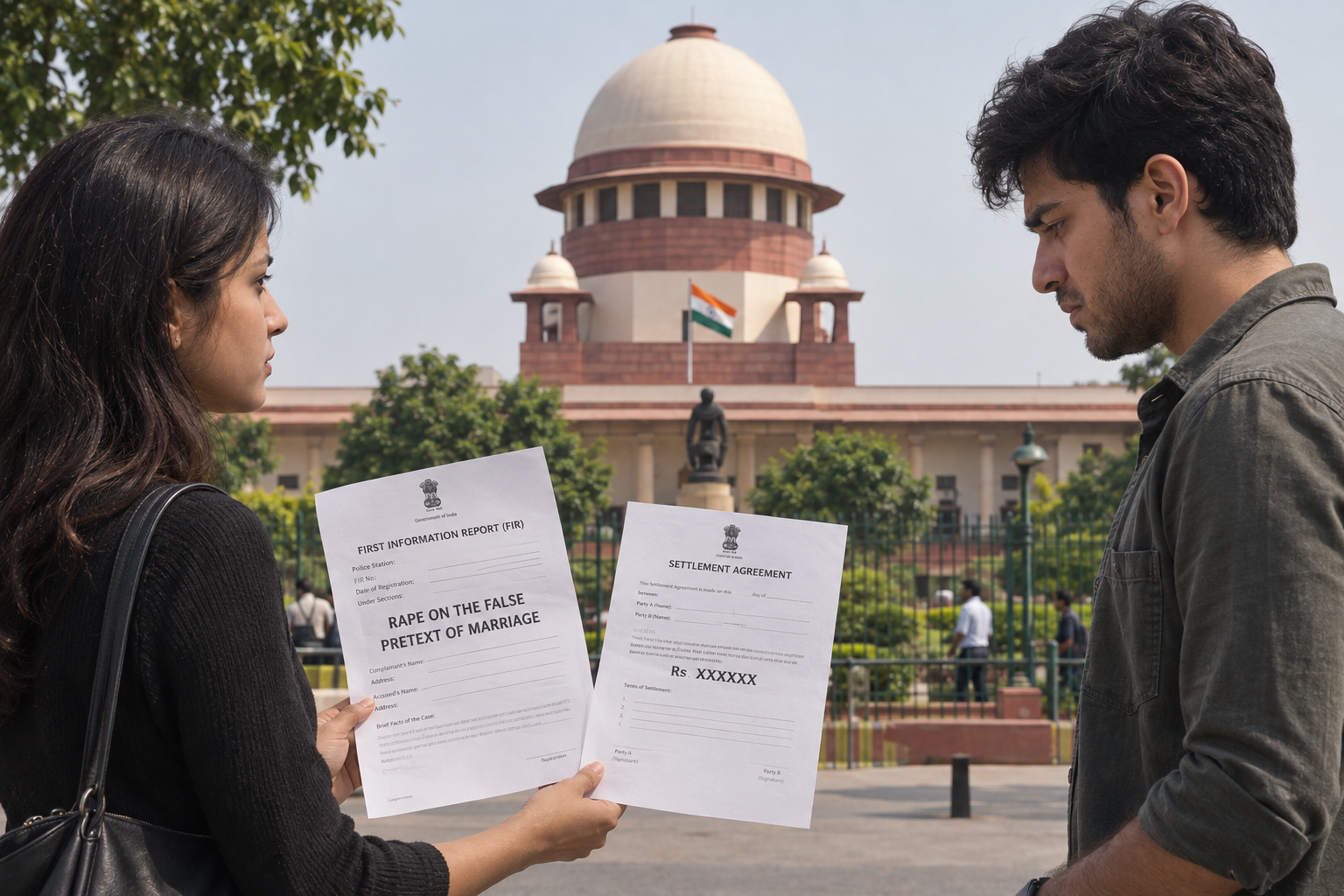
In Pooja Rani v. State of Haryana & Anr., Supreme Court slammed the practice of using criminal proceedings arising out of consensual relationships as a means of exerting pressure for monetary settlements, holding that such practices undermine the judicial system.
The petitioner, a 31-year-old woman, had registered an FIR on 12 January 2024, alleging that while she was attending to her brother, who was admitted to a hospital, respondent offered her assistance and subsequently became intimate with her. She alleged that he coerced her into sexual intercourse, and she willingly complied, believing that he would marry her, which he had promised. She further alleged that respondent's parents met her and a ceremony was conducted, following which she was abandoned.
Subsequently, parties entered into a settlement under which accused agreed to pay ₹9,25,000 to the petitioner, out of which ₹4,50,000 had already been paid. Punjab & Haryana High Court, upon examining the record, found that the case appeared prima facie mala fide.
Court also noted that petitioner was a mature woman who was conscious of her acts and conduct, and observed that allegations of sexual harassment on the pretext of marriage had set the criminal justice machinery into motion, which “undermines the sanctity of the legal process.”
High Court further cautioned against the criminal justice system being used as a tool for extracting money from the accused. In order to preserve the integrity of the criminal justice system, High Court set aside the settlement and made the balance amount unenforceable against the respondent. It also imposed a cost of ₹5 lakh upon the petitioner.
However, complainant challenged High Court's order but Supreme Court agreed with High Court's assessment of the manner in which the criminal proceedings had been used.
SC observed that High Court's order was “perfectly in order”, particularly in view of the manner in which allegations of molestation and sexual intercourse on the promise of marriage were subsequently settled.
Court also made it clear that judicial process cannot be permitted to become a mechanism through which criminal proceedings are initiated and subsequently leveraged for monetary settlements.
However, while strongly cautioning the petitioner against indulging in such conduct in the future, Supreme Court deleted the ₹5 lakh penalty imposed upon her.
Moreover, while dealing with the matrimonial proceedings, Supreme Court invoked its powers under Article 142 of Constitution of India and granted divorce to the parties.