
-
High Court


Kerala HC: Custody is the Child's Right to Both Parents, Not a Choice Between Them.

In this case, Kerala HC dealt with a habeas corpus petition filed by a mother alleging illegal detention of her 2 minor children (a son aged 10 and a daughter aged 12) by their father. The case, though framed as a habeas corpus plea, raised issues of child custody arising from matrimonial discord between the parents.

Court noted that the facts of the case reflected a larger pattern seen in custody disputes, where parental conflict overshadows the welfare of children. It observed that such litigation is often driven by ego and strife between parents, causing “irreparable trauma” to children who are involuntarily drawn into such disputes.
Court further highlighted how parents often misinterpret children’s behaviour during custody battles, attributing it to tutoring or bias. It clarified that “children are humans, conceding to emotions and needs like any adult,” and added that their responses are shaped by emotional vulnerability and circumstances rather than manipulation.
Moving beyond traditional approaches, Court strongly advocated for a shift in custody jurisprudence. It held, “The parent-centric evaluation of ‘child custody’ matters has to surely give way for a ‘children-centric’ approach, with specific emphasis on their physical, educational, social, and psychological requisites.”
Court stated that when it interacted with the children in chambers, they were crying inconsolably, saying that they want both their parents and requested the Court to intervene and end the dispute between them. This deeply influenced Court’s approach, shifting the focus from parental claims to the emotional needs of the children.

Ultimately, with the consent of both parties, Court crafted a balanced custody arrangement. Custody remained with the father, while the mother was granted weekend custody and equal time during holidays and vacations. Additionally, Court directed that the children must have unrestricted communication with the non-custodial parent at all times.
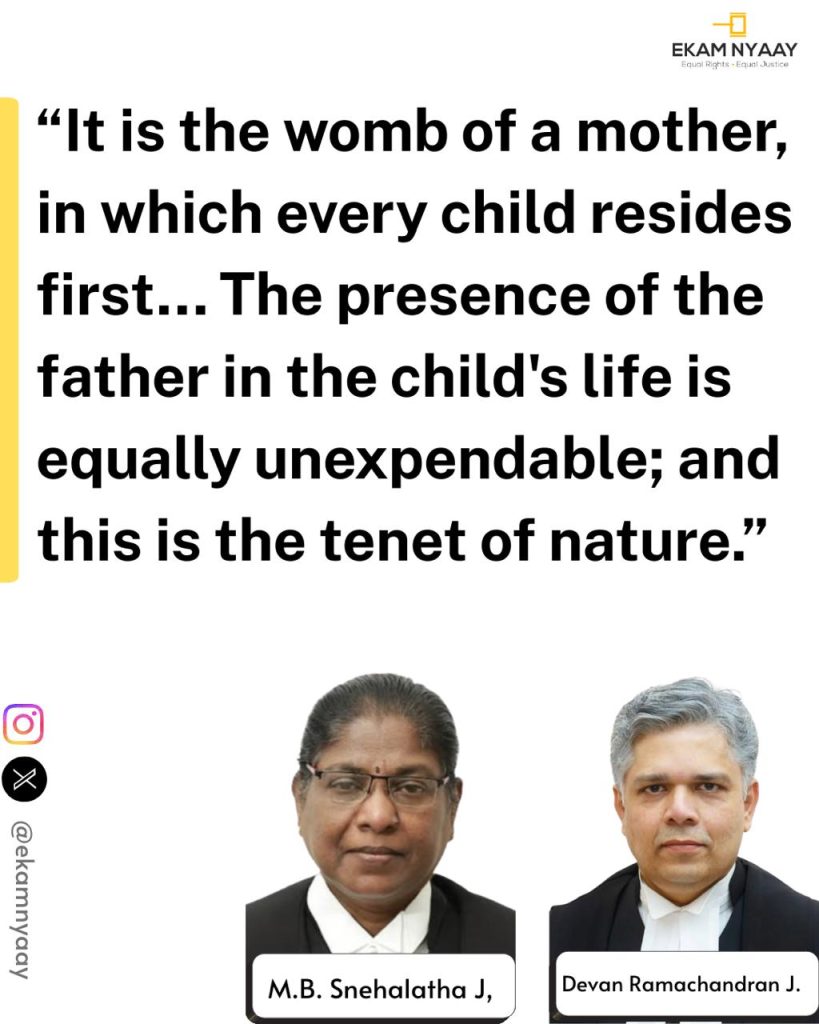
Court also laid down an important principle, “Custody is not an evaluation of choice between the parents… but recognition of the constitutionally protected rights of the child, to have both parents.”
It further stressed that courts must act in parens patriae to ensure that children live free from parental conflict, with “equal company… of both their parents.”