
-
High Court


P&H HC: SBI Branch Manager to be Reinstated after Dismissal from Service post Conviction under IPC 498a. Bank to Release all Benefits with 6% Interest from 2018.
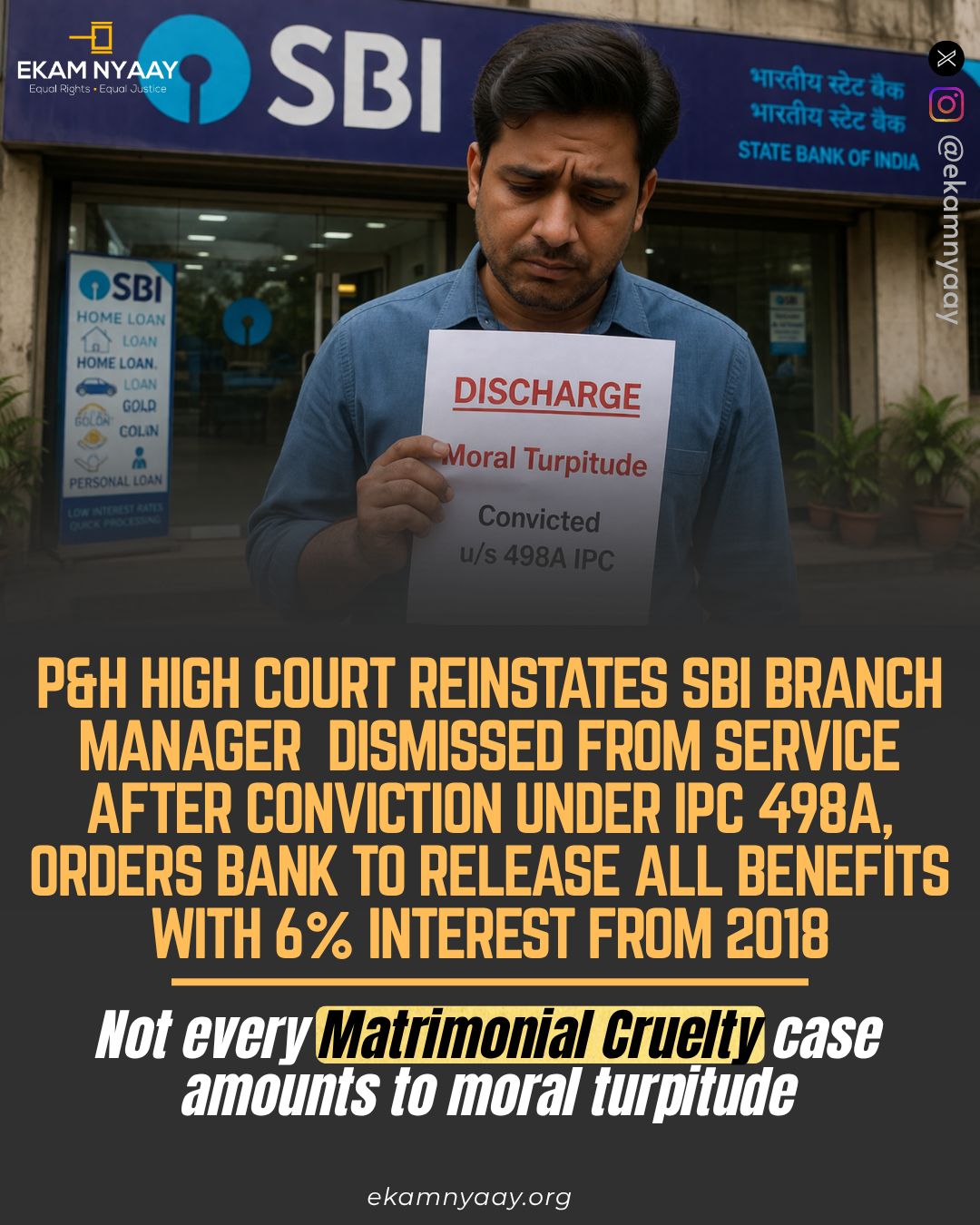
In Brahmjeet Kaushal v. UOI & Ors., P&H High Court reinstated the petitioner, an SBI branch manager, who was discharged from service following his conviction u/s 498A IPC, holding that not every such conviction amounts to an offence involving moral turpitude.
The case arose when the petitioner was removed from service in 2018 after being convicted u/s 498A IPC. Importantly, he had been acquitted of the charge of dowry death of his wife. Despite this, disciplinary authority treated his conviction as one involving “moral turpitude” and terminated his services without a detailed examination of the nature of the allegations.
Challenging the discharge, petitioner argued that the authority had mechanically applied the label of “moral turpitude” without considering the factual background, degree of cruelty involved, and his overall service record. He contended that matrimonial disputes often have complex personal dimensions and should not automatically result in severe civil consequences like dismissal.
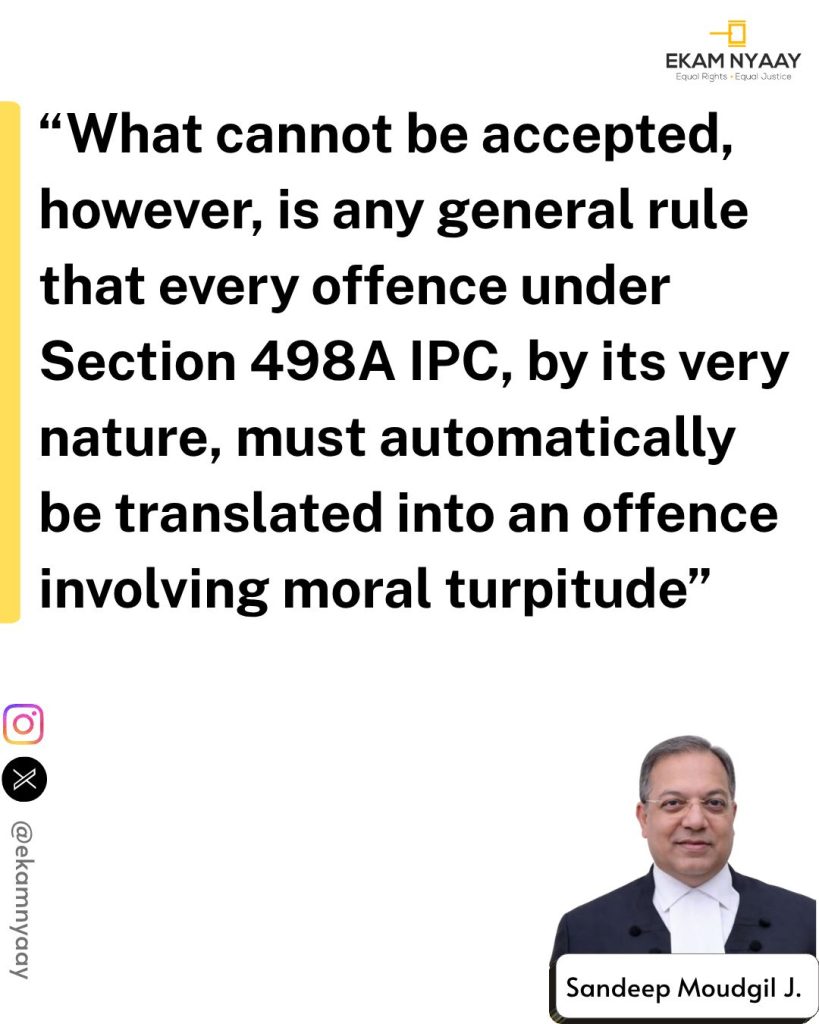
Justice Sandeep Moudgil emphasized the need to distinguish between serious cases of dowry harassment and those arising out of personal matrimonial discord.
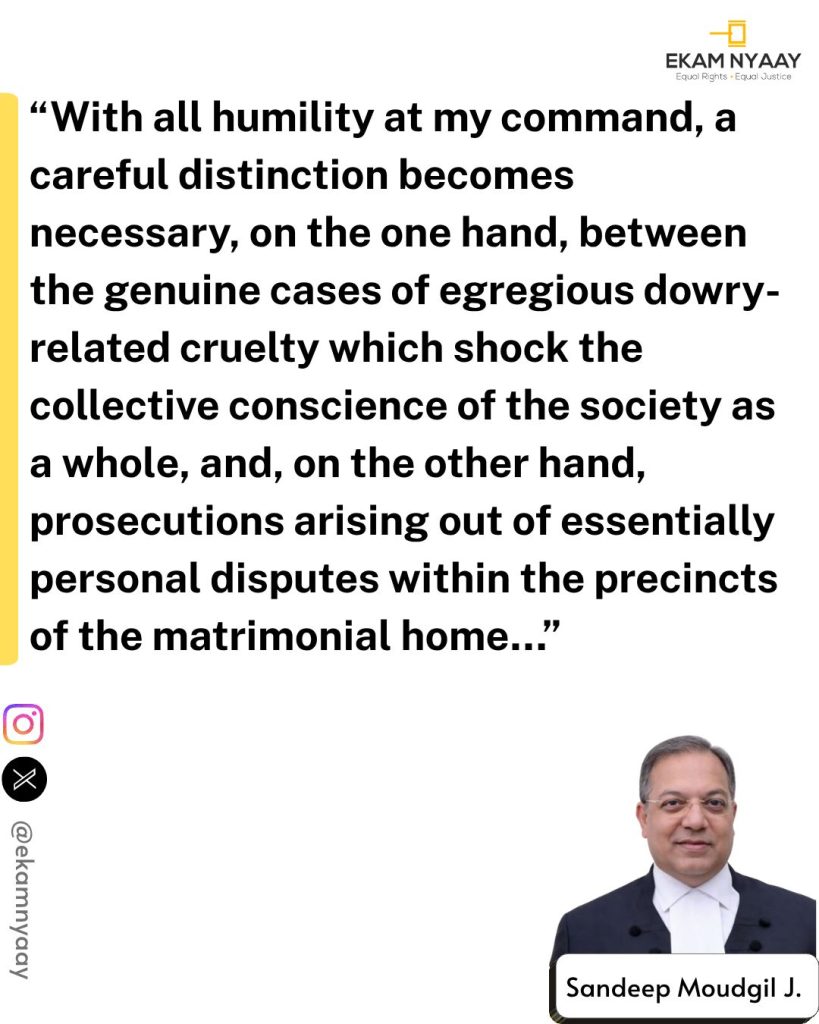
Court firmly rejected the idea of a blanket rule and, cautioning against overgeneralisation, held: “To elevate every prosecution under Section 498A, irrespective of its factual substratum, into an ‘offence against society’ is a proposition which cannot withstand legal scrutiny.”
Court also reiterated that moral turpitude refers to conduct that is inherently “base, vile, or depraved,” and such a label can be imposed only when the facts disclose genuine moral depravity, not merely a strained matrimonial relationship or technical findings of cruelty.
On the aspect of disciplinary action, Court held that authorities must undertake a proper evaluation and cannot merely rely on the expression “conviction involving moral turpitude.” They are required to assess the nature of the offence, its nexus with official duties, surrounding circumstances, employee’s service record, and proportionality of the punishment.
Accordingly, High Court set aside the discharge and directed that the petitioner be reinstated with all consequential benefits from 15.12.2018 along with interest at 6% per annum, to be paid within 2 months.