-
Other Court


Gurgaon Court: Husband Once Acquitted in IPC 498a Can Seek Damages From Wife for Malicious Prosecution Even If Wife Has Appealed Acquittal
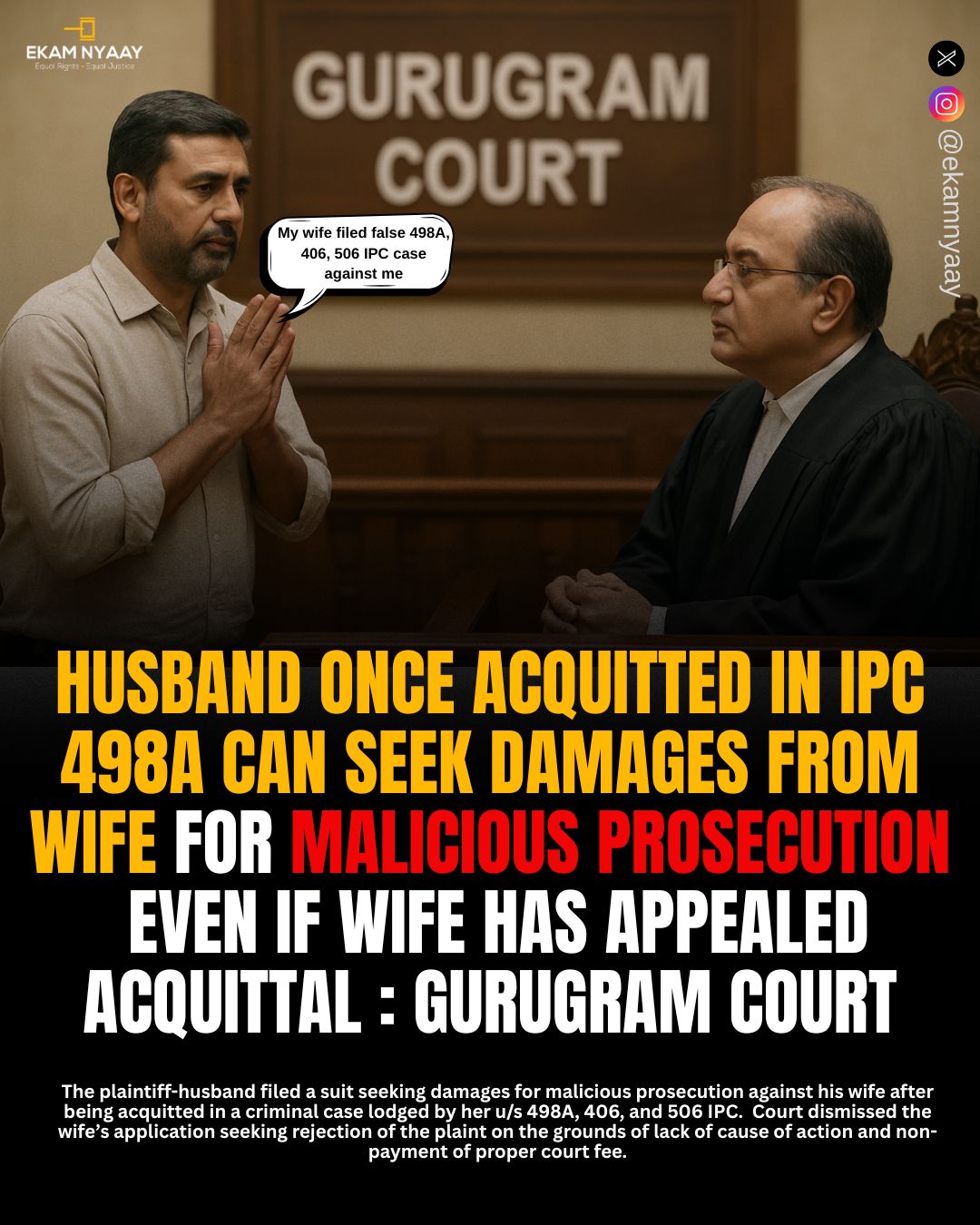
In this case, the plaintiff/husband filed a suit seeking damages for malicious prosecution against his wife after being acquitted in a criminal case lodged by her under Sections 498A, 406, and 506 IPC. The wife contended that the suit was false, lacked any cause of action, and that the plaintiff had not paid the requisite ad valorem court fee. She, therefore, moved an application under Order VII Rule 11 CPC, 1908, seeking rejection of the plaint on the grounds of lack of cause of action and non-payment of proper court fee.
The case arose from an FIR lodged against the Plaintiff by his wife on 18.05.2009 alleging cruelty. The trial concluded in his acquittal, but a Criminal Revision Petition filed in 2018 by his wife challenging his acquittal is still pending before the P&H High Court. The plaintiff claimed that the criminal proceedings were initiated with malice, without reasonable or probable cause, and had caused him damage. Defendant No. 2 argued that no cause of action arose on the dates mentioned in the plaint, the plaintiff concealed material facts, and he had approached the court with unclean hands.
The court first addressed the ground of lack of cause of action. It reiterated that for a claim of malicious prosecution, the plaintiff must prima facie show (a) institution of criminal proceedings by the defendant, (b) proceedings concluded in plaintiff’s favour, (c) absence of reasonable and probable cause, (d) malice, and (e) damage suffered.
Court noted that “The plaint, as filed, prima facie discloses these elements… Whether the plaintiff can substantiate these claims is a matter for trial and cannot be determined at this stage under Order VII Rule 11 CPC.”
The court further observed that the pendency of a revision petition against the acquittal does not negate the fact that the criminal case ended in the plaintiff’s favour at the trial stage. It held, “The contention of Defendant No. 2 that no cause of action arose… does not suffice to reject the plaint under Order VII Rule 11(a) CPC.” Thus, the suit disclosed a cause of action and could not be rejected at the threshold.
Regarding the issue of non-payment of ad valorem court fee, Defendant No. 2 contended that the plaintiff should have paid court fee on the entire amount claimed as recovery. The plaintiff countered that in suits for unliquidated damages (like malicious prosecution and defamation), the court fee is initially paid on a tentative valuation and adjusted if damages are awarded. The court, referring to Section 6 of Court Fees Act, held that “in a suit for damages… the plaintiff may assign a tentative value to the claim, subject to adjustment if the Court awards a specific amount.”
The court also relied on Amandeep Sidhu v. Ultratech Cement Limited & others, where it was held, “In a suit for damages for compensation for defamation or malicious prosecution – Ad valorem court fees cannot be ascertained at initial stage and suit may be entertained on the undertaking of the plaintiff for the payment of ad-valorem court fee at the decree amount.”
The court found no evidence that the court fee paid was inadequate or contrary to law. It clarified that if the plaintiff succeeded and damages were decreed, additional court fee would be payable as per the decree amount. Thus, the objection regarding non-payment of ad valorem court fee was unsustainable at this stage.
Therefore, court dismissed the application filed by wife to dismiss the suit and held, “The application… is found to be without merit. The plaint discloses a cause of action for malicious prosecution, and the issue of court fee does not warrant rejection of the plaint at this stage.”