-
High Court


Kerala HC: Circumstantial Evidence Sufficient to Deny Maintenance U/S 125 CRPC to Wife due to Adultery, Husband Can't Be Expected to Produce Evidence of Intimacy in Private
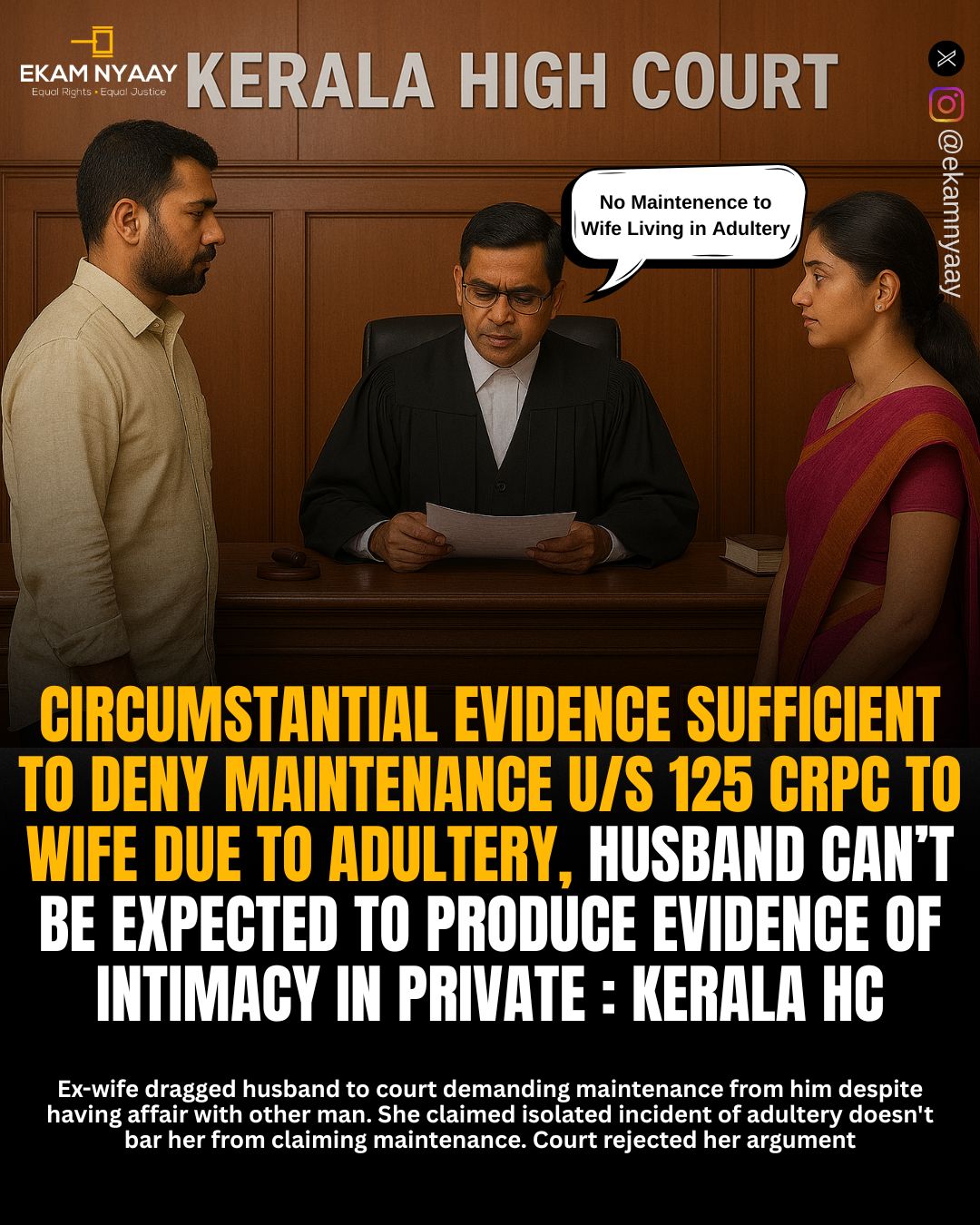
In Jinesh v. Aswathy, husband filed a revision petition in Kerala HC challenging the Family Court’s order granting monthly maintenance of ₹7,500 to the wife u/s 125 CrPC. The parties had married in 2003, and following marital discord, the husband obtained a divorce decree. The wife later filed a petition claiming maintenance, which the husband opposed on the grounds that she was “living in adultery” and therefore barred from relief u/s 125(4)
Husband argued that Family Court ignored clear evidence of continuous adulterous behaviour. He relied on medical records, witness testimony, call detail records, and divorce petition filed by the alleged paramour’s wife. The wife, however, argued that even if there was an “affair,” husband failed to prove continuous adultery as required in law.
Kerala HC noted that maintenance proceedings are civil in nature and therefore governed by the doctrine of preponderance of probabilities, not the criminal standard of proof beyond reasonable doubt.
It further observed that adultery typically occurs in secrecy, which makes it difficult to make direct proof and hence can be established through circumstantial evidence, provided the circumstances lead logically to that conclusion.
Evaluating the evidence, Court relied on the the testimony of the psychologist and treatment records where the respondent-wife admitted to an extramarital affair with the man named Ajith. It then relied on witness testimony, who stated he saw the wife and Ajith “hugging and kissing inside the car… in a semi-naked compromising position.”
High Court criticised the Family Court for dismissing this evidence merely because actual sexual intercourse was not witnessed, observing that such a narrow view defeats the purpose of Section 125(4).
The call detail records corroborated witness testimony by showing that both the wife and Ajith were under the same mobile tower location at the place and time of the compromising incident. Additionally, Court noted that Ajith’s own wife had filed for divorce alleging his adulterous relationship with the respondent. Court held these materials cumulatively proved a continuous adulterous relationship.
Therefore, Court held that “The aforementioned circumstantial evidence are sufficient to establish the factum of ‘living in adultery’ on a balance of preponderance and probabilities”
Accordingly, It ruled that the wife is disqualified from claiming maintenance u/s 125(4), set aside the Family Court’s order, and allowed the revision petition.