
-
Blogs

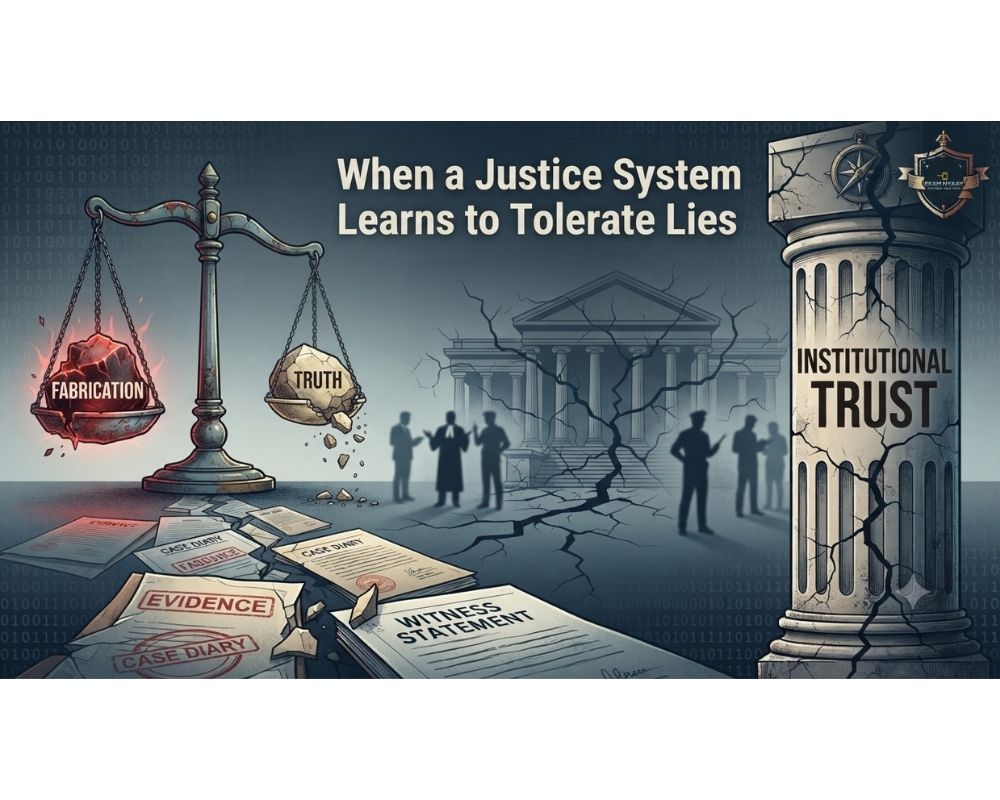
When a Justice System Learns to Tolerate Lies
Date: 11th September 2026
Introduction
What happens when a justice system becomes so accustomed to a problem that the explanations for not fixing it start reinforcing the problem itself?
India's culture of lying on oath is usually discussed as a problem of witnesses, litigants, lawyers or police. But the deeper issue is institutional: what happens when deliberate dishonesty carries insufficiently predictable consequences, while every attempt to enforce accountability is dismissed as too burdensome, potentially weaponisable, or historically inevitable?
This article examines that feedback loop: how tolerance can create incentives for further dishonesty, how unreliable evidence contributes to judicial delay, how institutional asymmetry affects public trust, and why the solution is not indiscriminate punishment but better evidence integrity, symmetrical accountability, independent investigation and institutional correction.
The larger question is not simply whether Indians tell the truth in court.
It is whether our institutions are designed to make truth reliable and deliberate deception irrational.
Because when institutional failure becomes normalised, the damage doesn't stop at the courtroom. It eventually becomes a question of rule of law, public trust, economic confidence and the credibility of the nation itself.
When a Justice System Learns to Tolerate Lies
The problem with India's culture of lying on oath is not simply that people lie. It is that the system can make lying rational.
An excellent recent analysis in Newsreel Asia examines the uncomfortable reality of false testimony, perjury and unreliable evidence in Indian courts.
But there is an even deeper institutional problem hiding underneath that analysis.
Some of the explanations offered for why the system tolerates these failures are themselves part of the problem.
We are repeatedly told:
- Courts are already overloaded.
- We cannot prosecute every lie.
- Perjury provisions could be weaponised.
- Witnesses make mistakes.
- Lawyers have to defend their clients.
- Investigations are imperfect.
These problems have existed for decades.
All of these observations can be true.
But none of them answers the fundamental institutional question:
What happens when the system's response to a recurring failure actually creates the conditions for that failure to become more common?
That is the problem we need to confront.
The Perjury Paradox
Consider the basic cycle.
Someone knowingly lies under oath.
The system does not act because prosecuting every lie would consume judicial resources.
The person therefore learns that the expected cost of lying is low.
More people become willing to exaggerate, conceal, fabricate or strategically contradict evidence.
Courts consequently spend more time determining what actually happened.
Cases become longer and more complicated.
The judiciary becomes even more overloaded.
The system then cites that increased workload as a reason why it cannot aggressively pursue falsehood.
And the cycle begins again.
In other words:
Overload → tolerance → strategic dishonesty → evidentiary uncertainty → more litigation → greater overload → more tolerance.
This is not merely a cultural problem. It is a systems-design problem.
"We Can't Prosecute Everyone" Is Not an Adequate Answer
Nobody is suggesting that every incorrect date, memory lapse or contradiction should result in a criminal prosecution.
That would be absurd.
There is an enormous difference between:
- an innocent mistake
- and
- deliberately fabricating a material fact.
A functioning justice system should be able to distinguish between them.
The answer is therefore not indiscriminate prosecution. It is targeted enforcement.
A sensible classification could be:
| Category | Description | Proposed Response |
| Innocent discrepancy | A genuine memory or factual error. | None. |
| Immaterial falsehood | An incorrect fact that has no meaningful bearing on the case. | None or judicial warning. |
| Material contradiction | A significant inconsistency requiring examination. | Judicial consideration and recording. |
| Deliberate material falsehood | Evidence indicates that a person knowingly lied about a matter relevant to the proceedings. | Perjury inquiry/proceedings. |
| Systemic fabrication | Evidence suggests that police, officials, intermediaries or other institutional actors participated in creating false evidence. | Independent investigation and appropriate disciplinary/criminal consequences. |
The objective is not:
"Punish everybody."
It is:
"Make deliberate deception predictably costly."
The More Dangerous Problem: Institutional Asymmetry
One of the legitimate concerns about stronger perjury enforcement is that the State could potentially weaponise it against ordinary citizens.
That concern should be taken seriously.
But there is a fundamental flaw in using that concern to justify weak enforcement.
If the State might abuse a power, the answer should not automatically be to abandon the power.
The answer is to build symmetry and safeguards.
If a citizen is accountable for deliberate falsehood:
- Police officers must be accountable.
- Investigating officers must be accountable.
- Government officials must be accountable.
- Government lawyers must be accountable for deliberate misrepresentation.
- Experts must be accountable for knowingly fabricated evidence.
- Private litigants must be accountable.
- Witnesses must be accountable.
The principle should be simple:
The obligation to tell the truth cannot depend upon which side of the courtroom you occupy.
The Police Evidence Problem
This becomes particularly serious when the issue moves from an individual witness to the investigative machinery of the State.
A witness who lies is problematic.
But an investigation that manufactures the evidentiary narrative is potentially far more damaging.
The police may control:
- the initial complaint;
- investigation;
- seizure;
- witness identification;
- statements;
- forensic referrals;
- arrests;
- case diaries;
- charge sheets;
- preservation of evidence.
If the evidentiary chain is corrupted upstream, the courtroom may be attempting to discover the truth from evidence that has already been contaminated.
That is not merely "bad testimony."
It is institutional evidence failure.
The solution should therefore include genuinely independent mechanisms for investigating allegations of:
- fabricated evidence;
- coached witnesses;
- manipulated statements;
- suppressed exculpatory evidence;
- fabricated seizure records;
- falsified investigative documentation;
- deliberate misrepresentation to courts.
An institution accused of manufacturing evidence should not always be the sole institution trusted to investigate that allegation.
The Lawyer Incentive Problem
There is another uncomfortable reality.
A lawyer's job is to represent the client.
If opposing testimony appears false, a lawyer's immediate incentive is generally to attack its credibility and win the case.
The lawyer may have little incentive to initiate a separate institutional process designed to improve the integrity of the justice system as a whole.
That is not necessarily unethical.
It is simply an incentive structure.
And whenever an important function depends on "someone" voluntarily performing it without a defined responsibility, that function tends to be neglected.
The solution is therefore to create an Evidence Integrity Function within the justice system itself.
Courts and registries could flag patterns such as:
- materially contradictory affidavits;
- obvious documentary fabrication;
- repeated false statements;
- suspicious witness reversals;
- unexplained evidence-chain gaps;
- serious contradictions between official records.
The purpose would not be to interfere with advocacy.
It would be to ensure that serious threats to evidentiary integrity do not disappear simply because every participant has another primary objective.
Judicial Workload Is Part of the Problem; But Also Part of the Feedback Loop
The argument that Indian courts are overburdened is entirely legitimate.
But judicial workload cannot become an all-purpose justification for tolerating the behaviours that contribute to that workload.
Imagine a factory saying:
"Our machines keep breaking, but maintenance takes too much time, so we cannot afford maintenance."
Eventually, the lack of maintenance becomes one of the reasons the factory cannot operate efficiently.
Justice systems are similar.
More judges are important.
More courtrooms are important.
Better infrastructure is important.
But throughput also depends upon:
More judicial capacity + better evidence + better investigations + faster procedural filtering + predictable accountability.
The goal should therefore not simply be:
more judges.
It should be:
More judicial capacity + better evidence + better investigations + faster procedural filtering + predictable accountability.
Historical Continuity Is an Explanation; Not an Excuse
Yes, false testimony and perjury have existed for generations.
Yes, many of these problems have historical roots.
But saying:
"It has always been this way"
does not explain why it should continue.
In fact, institutional persistence should trigger the opposite question:
What mechanisms have allowed this behaviour to survive successive legal and political regimes?
Calling something "Indian culture" can unintentionally shift responsibility away from institutions.
A more useful formulation is:
People adapt to institutional incentives.
If dishonesty is consistently rewarded or insufficiently penalised, strategic dishonesty becomes more likely.
If truthfulness is consistently protected and deception carries predictable consequences, behaviour changes.
This isn't uniquely Indian.
It is human institutional behaviour.
The Wrongful-Prosecution Problem
There is another side to the equation that deserves equal attention.
What happens when the system gets it wrong?
A person may spend years:
- defending a criminal case;
- paying lawyers;
- losing employment opportunities;
- suffering reputational damage;
- dealing with family consequences;
- living under the shadow of an accusation;
only eventually to be acquitted.
An acquittal restores legal freedom.
It does not necessarily restore:
- time.
- money.
- reputation.
- career.
- relationships.
- lost opportunities.
If wrongful prosecution is treated merely as:
"The prosecution failed; the case is over."
then the institutional cost of erroneous state action remains largely externalised onto the citizen.
A mature justice architecture should therefore consider a statutory wrongful-prosecution compensation framework.
Importantly, that does not mean automatically punishing individual officers.
The sequence should be:
State compensation → independent assessment of fault → disciplinary/ personal consequences where deliberate misconduct is established.
That creates accountability without making investigators afraid to act in legitimate cases.
The Real Damage Is Bigger Than the Courtroom
This is where the issue becomes a national institutional question.
A justice system teaches society what behaviour is rational.
If citizens repeatedly observe:
truth + evidence + patience = years of uncertainty
while:
fabrication + influence + procedural manipulation = strategic advantage
then the lesson eventually travels beyond the courtroom.
It reaches:
- police stations;
- government offices;
- contracts;
- businesses;
- regulatory systems;
- family disputes;
- property disputes;
- taxation;
- commercial negotiations;
- everyday dealings.
The citizen begins learning that truth may be morally desirable but strategic behaviour is more important.
That is devastating for institutional trust.
Four Layers of Trust
The consequences can be understood through four levels:
- Citizen - Judiciary
"If I tell the truth, will the system protect me?" - Citizen - State
"If the State makes a false allegation against me, can I realistically defeat it?" - Citizen - Citizen
"Can I trust the representations, declarations, contracts and testimony of other people?" - International - India
"Can I rely on India's institutions when money, contracts, investment or legal rights are involved?"
That final question matters enormously for India's economic future.
Rule of law is not merely a philosophical concept.
It is infrastructure.
A reliable justice system lowers the uncertainty surrounding contracts, investment, property, employment, entrepreneurship and dispute resolution.
An unreliable one increases transaction costs.
But Can We Actually Measure the "Trust Damage"?
We should be careful here.
There is no credible formula allowing us to say:
"Perjury reduces India's national trust score by X points."
That would be false precision.
But we can observe the broader institutional indicators.
The World Justice Project's Rule of Law Index evaluates countries across areas including constraints on government power, absence of corruption, open government, fundamental rights, civil justice and criminal justice.
India's position remains a serious reminder that institutional effectiveness cannot be separated from national credibility.
The important point is not to claim:
"Perjury caused India's ranking."
The more defensible argument is:
The culture of tolerated falsehood is one manifestation of the broader institutional weaknesses that rule-of-law measurements attempt to capture.
The Most Dangerous Thing Is Not Failure
Institutions will fail.
Judges will make mistakes.
Police officers will make mistakes.
Witnesses will forget.
Lawyers will lose cases.
Investigations will occasionally be wrong.
No justice system can eliminate error.
The real danger begins when there is:
Failure + visibility + non-correction + rationalisation.
The public can tolerate an imperfect institution.
What destroys confidence is an institution that appears to know what is going wrong and repeatedly explains why it cannot correct it.
That creates cynicism.
And cynicism is contagious.
The Self-Reinforcing Cycle We Need to Break
People lie
  ↓
We cannot prosecute everyone
  ↓
Lying becomes relatively low-risk
  ↓
Evidence becomes less reliable
  ↓
Cases become more complicated
  ↓
Courts become more overloaded
  ↓
We cannot spend more resources on perjury
  ↓
People continue lying
  ↓
Citizens lose confidence
  ↓
Informal influence and private pressure become more attractive
  ↓
Confidence in formal institutions declines further
That is the equilibrium we need to redesign.
What Would a Better System Look Like?
I would propose a broader National Evidence Integrity Framework.
Not simply "stronger perjury laws."
- Pillar 1 — Materiality: Target deliberate falsehood that matters to the proceedings.
- Pillar 2 — Judicial Recording: Create standardised recording of serious suspected false evidence.
- Pillar 3 — Independent Investigation: Institutional allegations should have access to genuinely independent investigation.
- Pillar 4 — Symmetrical Accountability: The truth obligation applies equally to citizen, police, government, lawyer, expert and witness.
- Pillar 5 — Digital Evidence Architecture: Use secure timestamps, provenance records and tamper-evident systems wherever practicable.
- Pillar 6 — Witness Integrity: Expand reliable audio/video recording of important testimony and investigative interactions.
- Pillar 7 — Evidence Provenance: Make the chain of custody and origin of important evidence auditable.
- Pillar 8 — Better Judicial Metrics: Don't measure courts merely by "How many cases were disposed?" Also measure:
- unreasonable delay;
- adjournments;
- evidence-related delays;
- age of pending cases;
- compliance with procedural deadlines;
- reversal patterns;
- enforcement of judgments;
- serious false-evidence referrals.
- Pillar 9 — Wrongful-Prosecution Compensation: Give innocent citizens a meaningful institutional remedy.
- Pillar 10 — Public Transparency: Publish anonymised annual statistics:
referrals -> inquiries -> prosecutions -> outcomes -> sanctions.
What gets measured becomes visible. What becomes visible can be governed. What can be governed can be improved.
The Principle Should Be Simple
We should not build a justice system in which people are terrified of making mistakes.
We should build one in which people are rationally discouraged from deliberate deception.
That means:
- Honest mistake Correct it.
- Reasonable disagreement Litigate it.
- Legitimate challenge to evidence Protect it.
- Deliberate fabrication Investigate it.
- Proven material deception Sanction it.
- Institutional fabrication Investigate the institution independently.
- Wrongful prosecution Provide a remedy.
That is not an anti-police position.
It is not an anti-lawyer position.
It is not an anti-judge position.
It is not an anti-citizen position.
It is pro-institution.
The Goal Is Not to Criminalise Imperfection
The goal is to make deliberate dishonesty irrational.
That distinction matters.
A justice system must tolerate human imperfection.
It cannot afford to normalise calculated fabrication.
Because once deliberate fabrication becomes rational, the courtroom gradually stops functioning primarily as a truth-finding institution.
It becomes a contest between competing narratives in which the most strategically useful version of events can sometimes become more important than the most truthful one.
And when citizens internalise that lesson, the damage extends far beyond individual cases.
India's Institutional Trust Is a Strategic Asset
India's greatest institutional opportunity is not merely to digitise courts.
It is not merely to increase the number of judges.
It is not merely to clear the backlog.
It is to build a justice architecture in which citizens can reasonably believe:
If I tell the truth, preserve my evidence and follow the law, the institution will recognise and protect that truth.
That is the foundation of trust.
And trust is ultimately what makes institutions powerful.
The solution to India's justice problems therefore cannot be:
"This is how the system works."
It has to become:
"This is what the system is designed to prevent; and here is the mechanism that corrects it when it fails."
Because a mature democracy is not one in which institutions never fail.
It is one in which institutional failure reliably triggers institutional correction.
That is the reform India should be aiming for.
Not more punishment for its own sake.
Not more bureaucracy.
Not more rhetoric.
But better institutional design.
Authored by:
Piyush Auluck, Founder & CEO
CyiQ A.I
piyushauluck@gmail.com | piyushauluck@cyiq.in
More In this segment
-

-
Blogs
- July 2026
-
-

-
-