
-
Blogs


The Other Side of Domestic Violence: The Invisible Victims Often Overlooked

India's official crime data record homicide by the sex of the victim, but do not provide a separate classification based on the victim's relationship with the accused, leaving husband killings by wives or intimate partners outside the national crime statistics. A documentation of 554 reported husband murders and suicides in just 195 days raises important questions about domestic violence, mental health, the limitations of crime data, and whether every victim receives equal recognition in research, policy and public discourse.
Domestic violence is one of India's most pressing social concerns. Public discourse, legislation and policy have rightly focused on protecting women from abuse within families, reflecting the widespread and well-documented nature of violence against women. Yet violence within intimate relationships is not experienced by one gender alone. While national crime statistics record murders and suicides, they do not identify the relationship between homicide victims and the accused, leaving India without an official record of how many husbands are killed by spouses or intimate partners.
To better understand this gap, Gurugram-based Ekam Nyaay Foundation documented media-reported cases of husband murders and husband suicides between 1 January and 14 July 2026. During these 195 days, the Foundation documented 554 cases—including 322 husband murders and 232 husband suicides—compiled from Hindi and English news reports. The Foundation makes it clear that these are not official national figures and that the actual number is likely to be much higher because many crimes never receive media coverage.
Apart from not only proving the scale of the problem, the documentation highlights the consequences of not officially measuring it. Without reliable data, researchers cannot accurately study patterns, policymakers cannot assess the effectiveness of interventions, and society is left debating an issue that remains largely outside official statistics.
The report therefore raises a broader question: Can public policy effectively address a form of violence that it does not systematically record?
"Justice begins with recognition. Before every victim can receive justice, every victim must first be counted."
When Home Becomes Dangerous
The Foundation documented 322 reported husband murders in just 195 days, revealing a disturbing pattern of violence within intimate relationships.
According to the report, 194 cases (60.2%) were linked to alleged extramarital relationships, making adultery the most frequently documented motive.
Another 88 cases (27.3%) arose from domestic disputes, while the remaining cases involved monetary conflicts, family conspiracies and other personal disputes. Rather than isolated acts of violence, the documentation suggests that many of these deaths followed prolonged relationship conflicts that gradually escalated into fatal outcomes.
The methods described in the documented cases are equally disturbing. Investigators alleged incidents involving poisoning, strangulation, stabbing, electrocution, burning alive, beheading, dismemberment, burial beneath house floors, and pushing victims into deep gorges. In several cases, murders were allegedly staged as accidents or suicides, while others involved elaborate conspiracies between wives, alleged lovers or family members to conceal the crime. The report itself highlights 25 particularly gruesome cases to illustrate the extreme nature of some incidents.
Yet, the greatest tragedy lies not in the brutality of the crime but in the betrayal behind it. These were not random acts of violence between strangers; they occurred within relationships built on trust, companionship and family.
Behind every documented murder was a child who lost a father, parents who buried a son, and families whose lives were permanently altered. The Foundation also notes that it deliberately excluded cases where women acted in self-defence or where the deceased had sexually abused daughters, reflecting an effort to document a specific category of intimate partner violence rather than every homicide involving spouses.
Suicide and the Hidden Distress
While murders often make headlines, the Foundation's documentation suggests that many men lose their lives through a quieter and more prolonged crisis. During the same 195-day period, it documented 232 husband suicides. Domestic disputes accounted for 104 cases (44.83%), 57 cases (24.57%) involved allegations of harassment by wives or in-laws, and 29 cases (12.5%) were linked to alleged extramarital relationships. The remaining documented cases involved allegations of false criminal accusations, harassment by girlfriends or their families, financial disputes and other relationship-related factors.
Unlike murder, suicide is rarely the result of a single incident. The documented cases point instead to prolonged emotional distress, unresolved domestic conflict and growing isolation. Several victims reportedly left detailed suicide notes or recorded videos alleging sustained mental cruelty, harassment, false criminal cases, denial of access to their children, financial pressure or years of marital discord. The research report identifies mental cruelty as the most frequently documented factor in the suicide cases it analysed, alongside threats of legal action, pressure to separate from parents, property-related demands, alleged false accusations and the emotional impact of extramarital relationships. The report also highlights the limited legal framework and institutional support available to men facing domestic abuse, leaving many without a specific legal avenue or support system comparable to those available to women. Combined with social expectations that discourage men from expressing vulnerability or seeking psychological help, this can leave some suffering in silence until a crisis becomes irreversible.
Every documented suicide represents more than a personal tragedy. It reflects a family left with unanswered questions, children growing up without a father, and parents trying to understand how domestic conflict escalated into the loss of a life. More importantly, it reminds us that before many suicides lies a period of distress that may have gone unnoticed, unrecognised or unsupported.
The societal Cost Beyond the Headlines
The impact then moves beyond the individual to the family system. Parents lose children, children lose parents, and families face emotional trauma, financial insecurity and prolonged legal or social conflict. For children in particular, the consequences can extend into their future—affecting their emotional security, understanding of relationships and ability to build healthy families of their own.
At the next level lies the institution of marriage itself. Marriage depends on companionship, trust, communication and the ability to resolve conflict without turning adversarial. When marital disputes increasingly become associated with violence, prolonged litigation, separation and suicide, they raise concerns about the resilience of the institution and the support available to couples when relationships begin to break down.
The consequences also reach the broader relationship between men and women. If either gender begins to see the other primarily through the lens of violence, exploitation, false allegations or legal vulnerability, fear and mistrust can replace cooperation. A healthy society cannot afford a growing perception that marriage is a conflict between opposing sides rather than a partnership between two individuals.
Ultimately, the concern is larger than individual marriages. Families are the basic units through which societies raise children, provide care and create social stability. When repeated relationship breakdown, violence, psychological distress and loss of life remain unaddressed, their cumulative effect can weaken families, affect children's futures, reduce social and economic productivity, and deepen divisions between men and women. The purpose of recognising these cases is not only to predict social collapse, but to recognise an early warning signal and intervene before private suffering becomes a public tragedy
When the Law Sees Only One Victim
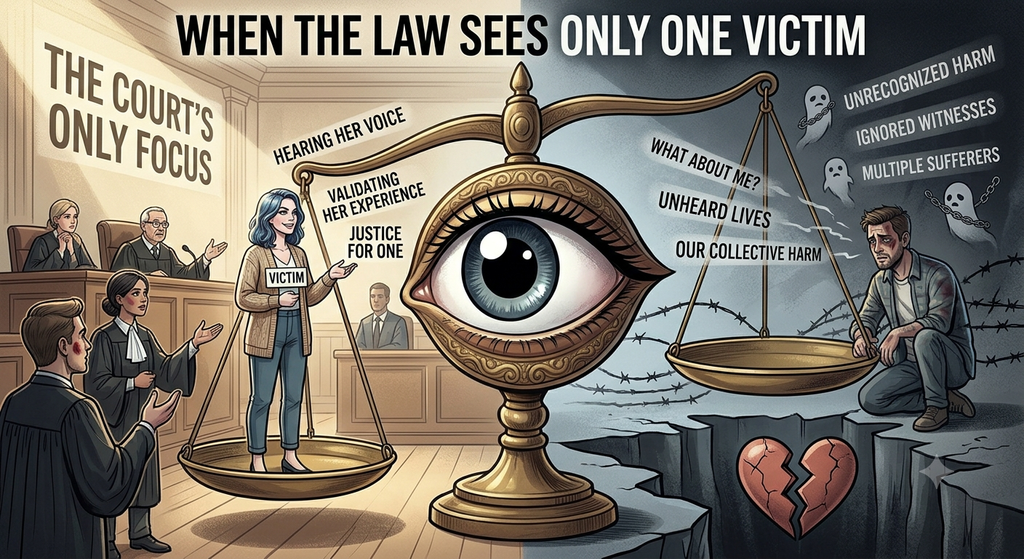
India has enacted important laws to protect women from domestic violence and matrimonial abuse, reflecting the widespread and well-documented nature of violence against women. However, the current legal framework offers comparatively limited recognition and support for men who experience domestic violence, coercive control or psychological abuse. While abuse is defined by behaviour rather than gender, institutional responses often continue to view men primarily as perpetrators rather than potential victims.
The reports also document cases in which victims or their families alleged prolonged legal harassment, false matrimonial or criminal accusations, denial of access to children, and years of litigation that contributed to severe emotional distress. They highlight an important principle: the legal process itself can have profound personal, financial and psychological consequences, regardless of how a case is ultimately decided.
A justice system is strongest when it protects genuine victims while ensuring fair investigation, early closure of false cases with penalising the false case filer and due process for everyone. Recognising that men can also become victims of domestic abuse does not weaken protections for women; rather, it broadens the principle that violence, coercion and psychological abuse deserve attention irrespective of the victim's gender. Better data, gender- inclusive support mechanisms and evidence-based policymaking can strengthen justice for all.
The Cost of Silence
“Silence does not mean the absence of suffering; sometimes it is evidence of how invisible that suffering has become.”
The silence is not only institutional; it is also visible in the media. The Foundation's research found that many documented cases of violence against men appeared mainly in regional media, while mainstream outlets often reported them only when they were exceptionally brutal or specifically highlighted by police.
This becomes particularly important when compared with the way violence against women is discussed in public life. Sustained reporting has helped make violence against women a recognised social and policy issue; however, limited coverage of male victims can leave the reverse form of violence—where women are alleged perpetrators and men are victims—largely outside the public conversation. The Foundation's research argues that this imbalance can reinforce the perception that men are only perpetrators and women only victims.
The answer is not to reduce coverage of violence against women or create a competing gender narrative. It is to apply the same journalistic seriousness to verified cases regardless of the victim's or perpetrator's gender.
Newsrooms can strengthen reporting by tracking cases from regional media, translating significant reports, verifying allegations carefully, identifying broader patterns and giving legitimate cases proportionate coverage. Visibility matters because what society does not see is often what it fails to discuss, research and eventually address.Justice Begins with Recognition
The first step towards addressing any social problem is to measure it honestly.
India needs better data on intimate-partner violence, including the relationship between victims and accused in homicide cases, so that the scale and nature of the problem can be understood rather than inferred from scattered media reports. The Foundation has also called for greater research into male victimisation, stronger mental-health interventions, family counselling and gender-inclusive support mechanisms.
Legal reform must be approached with the same balance. Protecting women from violence remains essential, but recognising male victims does not take that protection away. A system that responds to violence on the basis of the conduct and harm involved, rather than assumptions about gender, can protect genuine victims while preserving due process for everyone. Allegations of abuse or false cases must be investigated fairly, evidence must determine outcomes, and neither victimhood nor guilt should be presumed solely from gender.
The objective should not be to create a contest between men and women over who suffers more. It should be to ensure that violence, abuse and psychological cruelty are recognised wherever they occur. Better data, responsible media coverage, accessible counselling, mental-health support, impartial investigation and evidence-based policy can help bring victims out of the shadows.
Ultimately, every number represents a human life and a family changed forever. Justice cannot be complete when some victims are visible and others remain invisible. Recognition is not a favour to any gender; it is the first condition of equal justice.
Justice begins by recognising the victim, hearing the allegation, examining the evidence, and refusing to let gender decide who deserves to be heard.
~ Author: Dr. Deepak Goel
More In this segment
-

-
Blogs
- October 2026
Intimacy as Leverage: Dating Scams and Honeytraps Exploiting Men in India
-
-

-
Blogs
- September 2026
-
-

-
Blogs
- July 2026
-
-